

Transition investing makes a difference
In 2018, one of the authors sat on the Rise Council, the impact advisory body of the TPG Rise Fund. With a USD 2.1 billion fund size, and substantially oversubscribed, it was then the largest impact fund ever raised. During one session, the fund’s co-founder described how the TPG brand and the involvement of rock band U2’s lead singer Bono had opened doors closed to others. These were amazing companies, he said, that could raise money anytime from anyone, and it was TPG that was able to secure an allocation.
The remark was meant to reassure the investors in the room that the portfolio was indeed full of financially promising companies. But it also described a market that had already found and priced these companies. Capital and investor interest were abundant, which is exactly the condition under which no single investor can claim to be additional. If a company can raise from any number of investors on similar terms, it is hard to argue that any one of them changed what it would go on to achieve. To his credit, Bono acknowledged the point.
That exchange captured the central challenge for transition investing. A fund can invest in excellent companies whose products and services are delivering real benefits while adding little new to the world, as the opportunity was visible to everyone and priced accordingly.
The opposite error is also common. Impact-focused investors seeking to avoid the first problem move towards the hardest, least commercial opportunities, and much of that capital ends up in ventures that simply fail, delivering no impact at all.
Between the deals that would have happened anyway and those that were never going to work lies a narrow band where capital is both additional and commercially viable. This article explores that band, which we define as the Goldilocks zone of transition investing.
Two kinds of additionality
An investment makes a difference at two levels, and both are needed before we can call it additional.
The first is at the level of the company. Imagine a firm bringing clean cooking stoves to rural households that no one else serves. If the firm succeeds, the world changes: fewer emissions, cleaner air, lower fuel bills. We call this change the company’s impact delta (Δ1): the change it makes to the world, measured against what would realistically have happened otherwise. It is potentially large where a market is failing badly, as the gap between what exists and what could exist is wide. It also works on the edges of technological innovation, where first movers can capture outsized returns and generate outsized impact. Where markets already work well (and technologies are mature), a new entrant would add little, since a competitor would have done the job anyway – and probably already does. Consequently, a company’s impact delta is related to the depth of market failure that the company is seeking to address.
The second is at the level of the investor. Even a company with a large impact delta may not need your money. If ten other investors are ready to fund it on the same terms, your capital changes nothing – you are simply taking someone else’s place. Your contribution depends on how hard it would have been for the company to secure that investment on the same terms without you. We call this Δ2, the investor’s share of the company’s impact delta, Δ1, and it is large only where capital markets are inefficient, illiquid or informationally constrained.
Putting the pieces together, the additionality of an investment is the product of three terms:
Additionality = 𝑝(𝛥1) × 𝛥1 × 𝛥2
Here p(Δ1) is the probability that the venture succeeds commercially and generates the expected impact. It falls as the market failure, and with it Δ1, deepens. Because the terms are multiplied, a zero anywhere means zero additionality. A highly attractive company that anyone would fund is not additional, and neither is scarce capital chasing a problem for which there is no viable commercial solution.
How solving a market failure creates value
A market failure is, in essence, underinvestment at equilibrium: the market supplies less of a product and service than it would in a perfect market with perfect information and no friction. That shortfall is surplus available for businesses and investors to collect (before competition inevitably shifts this surplus to consumers). A business that finds ways to close the gap releases this value, and the question for an investor is how much of that value can be realized by the company. There are two primary channels, and a third worth noting.
Direct value: Impact as cost saving and productivity improvement
In the first channel, impact and commercial value are different sides of the same coin.
Consider power generation in an African market where the grid is unreliable and much industrial demand is met by diesel generators. A new gas plant looks regressive against a European baseline, where the alternative is wind, solar, hydro or nuclear. Given the diesel and coal baseline that exists in much of Africa, gas lowers emissions against the counterfactual, lowers carbon intensity, lowers cost, powers development at scale and improves reliability. The delta is positive and large, and (it is hoped) temporary – when clean energy becomes cheaper than gas in that market, the same type of investment stops being additional and the baseline moves on. That is the nature of a transition baseline, which shifts as the market develops – an investment can be additional today and superseded tomorrow.
The same logic runs well beyond energy. Better labour practices can lower attrition and raise productivity. Resource efficiency cuts pollution and input costs through the same mechanism. In these cases, where it can be done, there is no trade-off: the impact metric and the margin improvement are collinear.
Indirect value: Impact as market creation
The second channel works differently. Serving a population that was previously unserved, in energy access, health, education or financial inclusion, does not make an existing business more efficient. It reveals or builds a market that was not previously seen as commercially viable. The financial and impact outcomes come from proving out what nobody had previously done: that dispersed customers can be reached, that they will pay if they see value for money, and that delivery models suited to informal or undeveloped markets can function.
Investors make the same error about these companies that incumbents make about their customers. Investors misjudge these opportunities because the returns are not obvious. Incumbents misjudge the underlying markets as too small or difficult to serve. Both errors have the same cause: nobody has done the work required to see the demand and how it might be satisfied.
This channel resembles, in some ways, Prahalad’s base-of-the-pyramid thesis, which drove a wave of microfinance and consumer-goods ventures in the 2000s and 2010s, much of which disappointed financially. The difference we argue for is a focus on scalable business driving economic growth in lower income countries, and not just a focus on serving the most underserved.
A third channel: risk and resilience
Some transition investments pay off in lower risk rather than higher margins. Diversified supply chains, avoided exposure to stranded assets and positioning ahead of tightening regulation show up in a lower discount rate or thinner downside tails. Fiduciary investors increasingly price these effects explicitly, even if they are harder to observe than a cost saving.
What cannot be captured
Not every market failure can be solved profitably, and this distinction is important for everything that follows. Some failures arise from frictions: poor information, coordination problems, and missing distribution and infrastructure. Others arise because the benefits or costs go to society rather than to the buyer and seller, as with unpriced carbon emissions or pure public goods. Solving these creates real value that no business can benefit from, however deep the failure or skilled the investor.
Failures of this kind become investable only once innovation lowers the cost of addressing them, or public policy prices them in, through taxes, subsidies or regulation.
Why the deepest problems are not the best targets
The deeper a market failure, the more potential value a successful business releases. But the deeper the failure, the less likely it is that a business can succeed at all.
Some failures are shallow: a service is slightly underprovided, and a competent firm making an effort others are not making can fill the gap. Others are so deep that no commercial venture can fix them alone, such as basic infrastructure in fragile states or technologies still decades from viability. These need further innovation, public money, regulation or philanthropy before private capital can play a role.
Figure 1 shows the two forces pulling in opposite directions. The dotted line is the impact a business delivers if it succeeds, rising with the depth of the failure. The dashed line is the chance that it succeeds, which stays high for a while and then falls sharply. Multiplying the two gives the solid line: the impact an investor can expect.
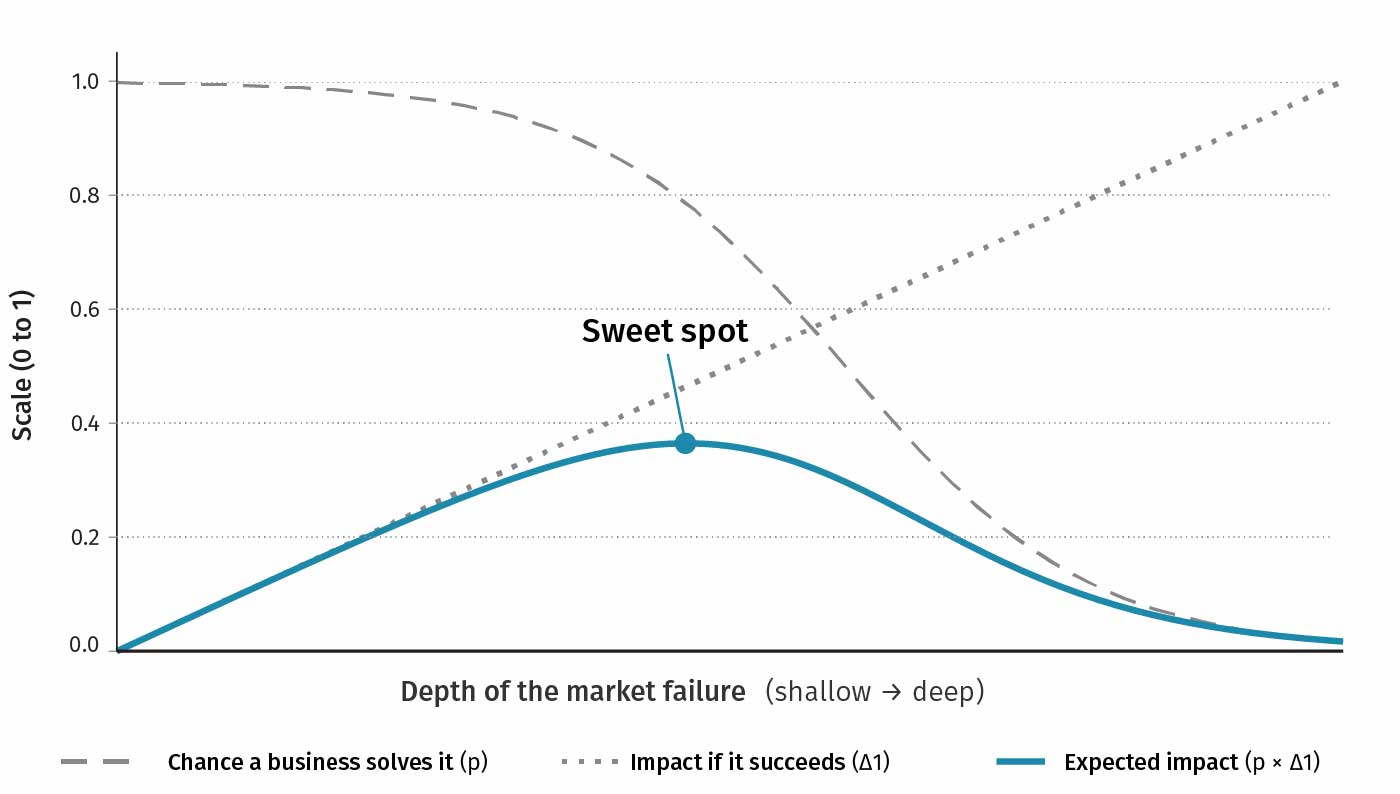
The result is a sweet spot. Too shallow, and there is little to change. Too deep, and the odds of changing it through commercial activity is are low.
What investors earn
Returns follow the same logic as impact: a deeper failure offers a bigger prize, but only to those who succeed. Figure 2 measures returns against the market, so the horizontal line is what an investor would earn elsewhere.
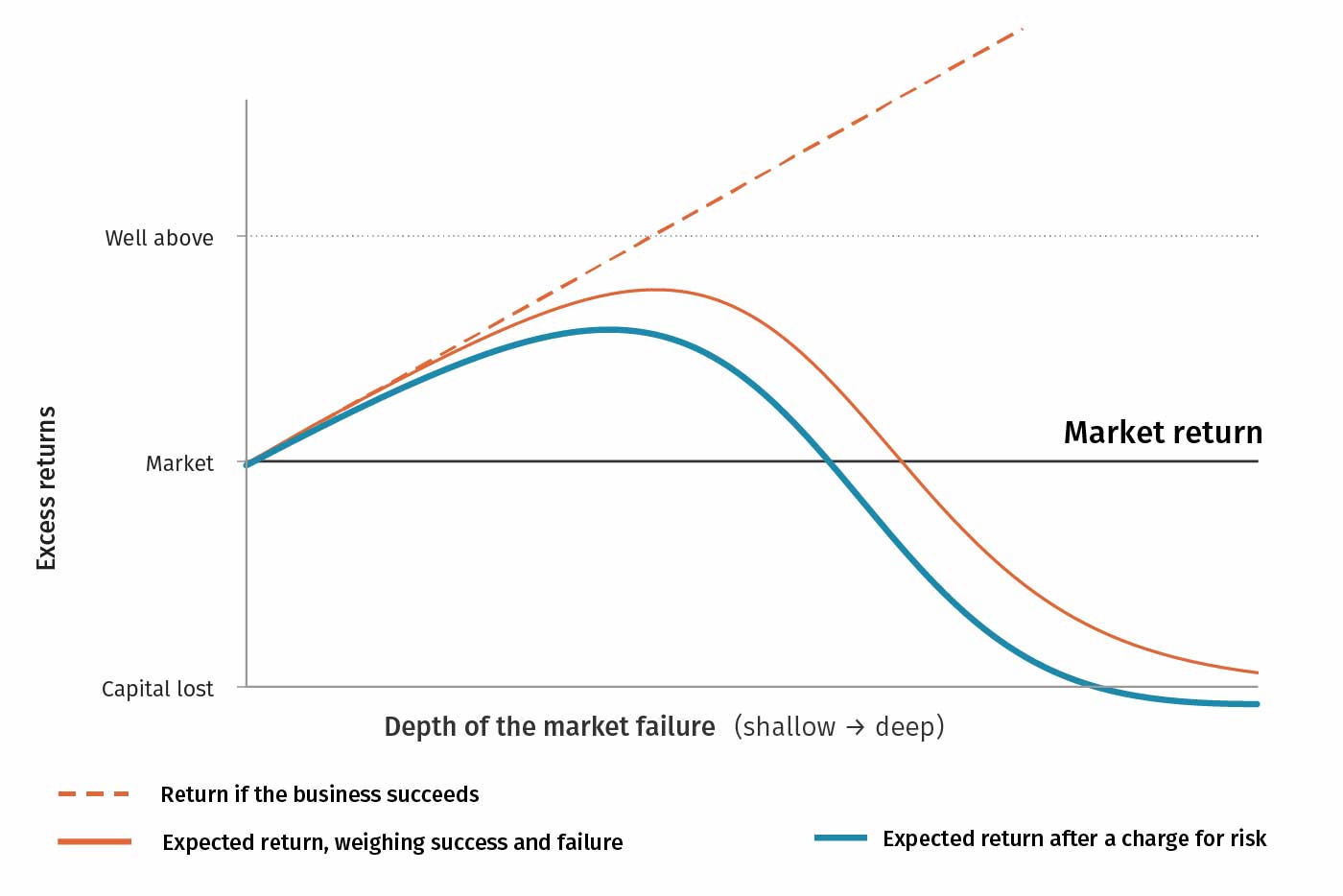
The dashed line is the return if the business succeeds. In a competitive market it earns roughly the risk-adjusted market return, as rivals compete away any excess. Where the failure is deeper, there is more unmet demand and less competition for capital, so success pays more.
The solid orange line is what an investor can expect once failure is taken into account. It tracks the prize while success is likely, then turns down as the chance of losing the capital outweighs the larger prize. For now, we assume capital markets price these opportunities correctly; the gain from buying into a mispriced market enters with Figure 3.
The purple line adds a charge for risk. An institutional fiduciary investor, such as a pension or sovereign wealth fund, cares about the spread of outcomes as well as the average. A venture that either triples or goes to zero is less attractive than a steadier one with the same mean. After this charge, returns peak earlier and fall below the market sooner. This is the line that determines what a fiduciary institution can hold on commercial terms.
Four zones
The investor’s additionality, Δ2, is determined largely by conditions in the relevant capital market rather than by the company alone, and we introduce it exogenously as our proxy for market inefficiency. Figure 3 is drawn for one given level of inefficiency. Its top panel multiplies the expected impact of Figure 1 by Δ2; its bottom panel shows excess returns after a charge for risk, now including the gain from buying into a mispriced market.
Combining the two tests – whether an investment makes a real difference and whether it earns at least the risk-adjusted market return – we can divide the landscape into four zones. Investor additionality is a sliding scale: it is zero where there is no market failure or where the capital market is fully efficient, and small but positive almost everywhere else. To separate a small difference from a meaningful one, the dashed line in the top panel sets an impact hurdle, the minimum additionality an investor requires before counting an investment as making a real difference.
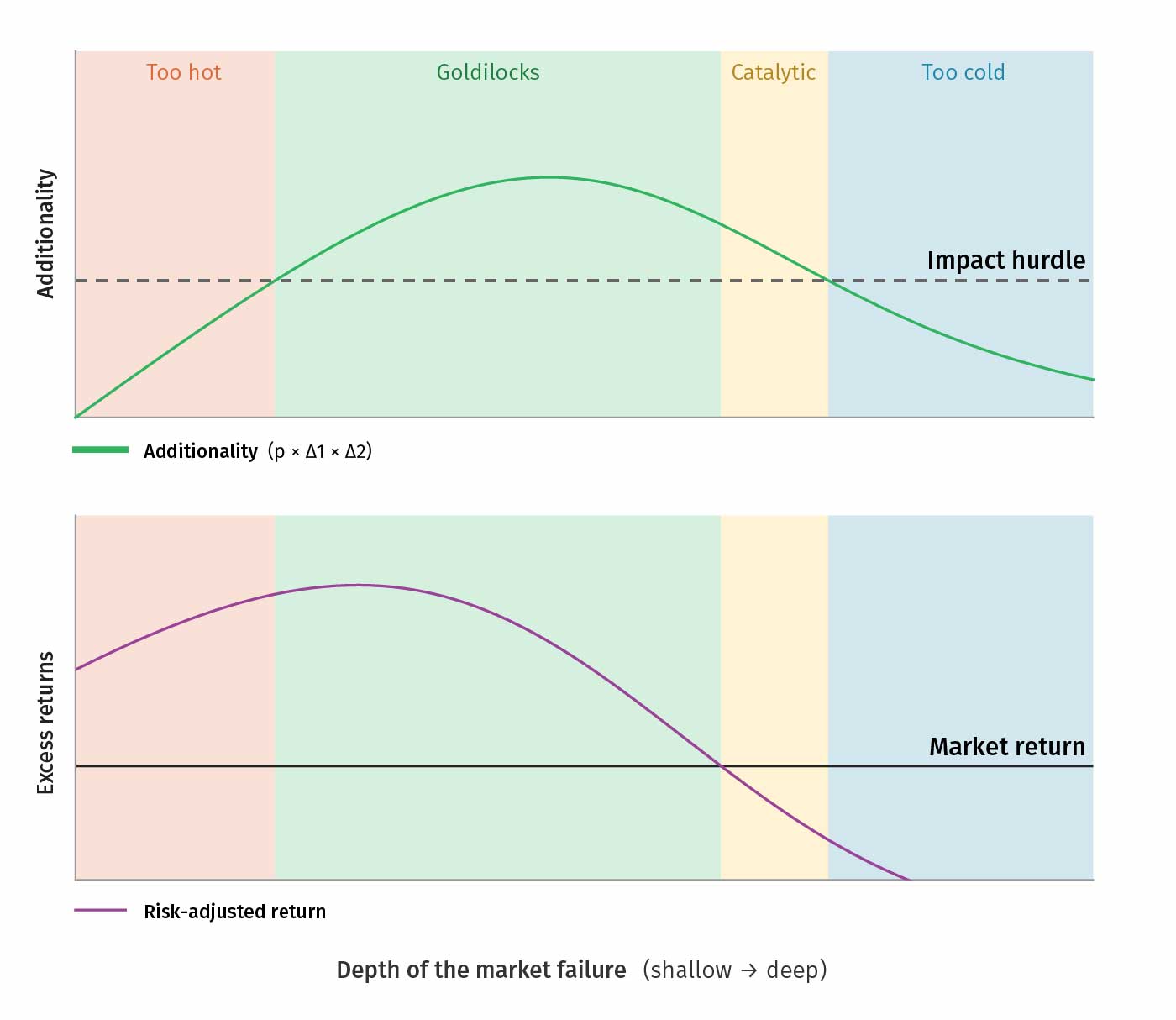
Too hot. Failures too shallow for additionality to clear the impact hurdle. Returns are at or above the market, but even an investor whose capital is hard to replace adds little when the company itself changes little.
Goldilocks. Intermediate market failures, where the difference made is large and risk-adjusted returns would be considered market rate.
Catalytic. Deeper failures, where a business can plausibly succeed and the difference made is large, but returns fall short of what the market would typically expect. This is the natural territory of development finance institutions and blended finance structures, which have mandates that allow for marginally lower returns or greater risk, for reasons explained below.
Too cold. Failures so deep that commercial success is unlikely. The sole backer of an uncommercial venture may be 100% additional in terms of the capital provision, but the chance of success, and with it the expected return and impact, collapses. These challenges are the domain of governments and philanthropies.
One detail in Figure 3 is important. Additionality peaks at deeper failures than returns do, so between the two peaks more impact costs some return. Each step towards a deeper failure makes success more valuable but less likely, and failure erases both the impact and the return. The difference lies in what is at stake. On the impact side, failure means delivering nothing, but nothing already achieved is lost, so a deeper failure is worth pursuing as long as the impact on offer grows faster than the odds of success fall. On the return side, the investor must also put capital at risk. A deeper failure raises the profit on success but not the capital, which is lost more often as the odds fall. Even if profit grew as fast as impact, expected returns would therefore turn down first. The charge for risk, which applies to returns alone, reinforces this.
This gap is what creates the catalytic zone. Beyond the point where returns fall below the market, additionality remains above the impact hurdle, so an investor willing to accept less than a market return can still buy substantial impact. This is the trade development finance institutions are designed to make: their concession buys impact where it remains high and commercial capital has already stepped back. How wide the zone is depends on how much of the value it creates that a business can turn into profit. Where that share is high, profits are large relative to the capital at risk, the two peaks move closer together and the catalytic zone narrows. Where it is low, the zone widens, and for failures whose benefits go entirely to society it covers everything that is not too cold.
Mispricing: why the zone exists
Neither additionality nor excess returns survives in an efficient, competitive capital market. Where information is plentiful and accurately priced, every visible opportunity is taken quickly. Capital is substitutable, so the alternative to any single investor is another on much the same terms, and the price already reflects the value on offer. Market inefficiency is the precondition for the strategy, for returns and for investor additionality alike.
The frictions associated with market inefficiency are well known. Information is scarce or costly, risk is priced off narratives and poor comparables, and coordination is expensive. Diligence costs can often deter entry altogether. Where these frictions come together, viable companies go unfunded or are priced as if they were weaker than they are. All investors price deals on their perceptions of a company. An investor with deep domain expertise and people on the ground has a perception that is closer to reality, and the distance between these two investor perceptions is where the opportunity arises.
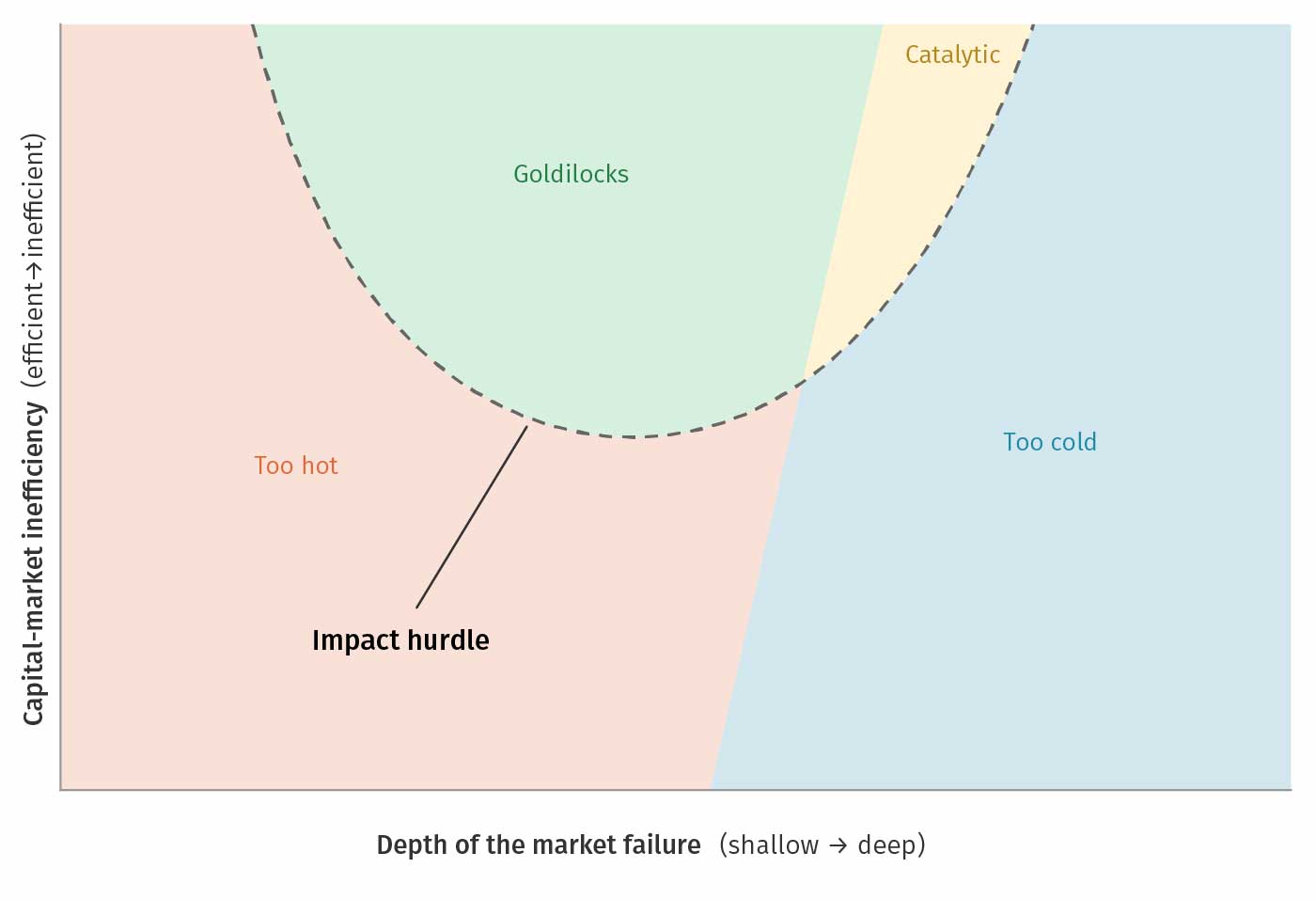
The dashed curve is the impact hurdle. Above it, the investor’s money makes a real difference; below it, it does not. Above the curve, green indicates that returns also beat the market (Goldilocks) and yellow that they do not (catalytic).
The curve is U-shaped because making a difference takes two things together: a company that changes a lot, and money that is hard to replace. In the middle, companies change the most, so the money needs to be only moderately scarce. Towards the edges, companies either change little (on the left) or rarely succeed (on the right), so the money must be much scarcer to make up for it.
At the bottom of the chart, capital is plentiful and every company is fairly priced. Any good company can raise money from many investors, so no single investor makes a difference. An investment here is too hot if the company earns enough to attract investors, and too cold if it does not, and where that line falls depends on the company’s prospects. This is the conventional view: in a well-functioning market, private capital cannot make a difference on commercial terms. It is arguably where much of the Rise Fund portfolio sat, and much of today’s sustainable investing with it.
Higher up, as capital becomes scarcer, a willing investor’s money matters more, and that investor can buy in cheaply. Once capital is scarce enough to reach the bottom of the U, the Goldilocks zone appears, and it widens further up. Market inefficiency is what allows an investment to make a difference and still earn a market return.
The edge is not free
Mispricing persists for a reason, as explained by Grossman and Stiglitz in 1980. Prices cannot fully reflect information that is costly to acquire, because if they did nobody would pay to acquire it. Equilibrium therefore leaves prices uninformed enough that informed investors earn roughly what it costs them to become informed. The gap persists at about the level where closing it stops paying.
For investors, this means the edge comes from capability rather than intention: domain expertise, local networks, and the ability to form a better view faster than others. If that expertise were easy to acquire, more investors would have it and the mispricing would be gone. It also means the view at the edge must eventually be incorporated by the market. Buying cheap becomes a return only if the market later recognises the value, through a sale, a listing or follow-on funding. Frictions that never dissipate simply mean buying cheap and selling cheap.
However, this equilibrium is not fixed. AI is lowering the cost of knowledge: Bain & Company’s annual survey of dealmakers found 21 per cent using generative AI in M&A at the start of 2025 and 45 per cent a year later. A manager in Nairobi or Lagos can now map a sector in hours and days rather than months and years. Verification and deep local knowledge still depend, of course, on trusted and competent people on the ground, but as the cost of forming a view falls, the gap narrows.
Each success also changes the situation for the next investor, in two directions at once. The first mover proves that the customers can be reached and the model can work, which raises the odds of success for whoever follows and pushes the catalytic boundary to the right. Its exit also gives the market a comparable, so the follower is willing to pay more and is easier to replace. The first effect is the theory of catalytic capital: a DFI takes a deep failure and makes it shallower for the private investor behind it. The second is the market learning. Which effect dominates determines whether the second mover lands in the Goldilocks zone, and in frontier markets, where capital markets learn slowly, we suspect it usually does.
Frontier markets: where the gap is widest
The framework predicts that the zone should be widest where information is most scarce. In much of Sub-Saharan Africa and frontier markets in the Middle East and North Africa, few deals are so transparently commercial that international investors line up to fund them. Strong companies routinely take many months to close a round. The economies are growing, yet analytical coverage is thin and the market’s view of a company can lag its actual position by years. The zone should be considerably wider in Lagos or Nairobi than in London.
A 2019 study of 365 emerging-market funds by the Shell Foundation and Omidyar Network found that SME funds had returned just 0.26 times paid-in capital in cash, against a total value of 0.84 once unrealised holdings were counted. For funds in the lowest-income countries the gap was wider still: 0.13 times paid-in distributed, 0.99 in total value. Currency movements, fees, elusive exits, unreliable counterparties and holding periods well beyond a fund’s life explain much of the gap. Money is being made in these growing economies, but it appears to have accrued more to owners, builders and lenders than to equity fund investors.
The persistence of the mispricing and the poor record of fund returns are not in contradiction. Frontier companies remain mispriced precisely because pricing them has not been worth anyone’s time through the vehicles available. The shortfall appears to say more about the approaches of western investors (for example, the limitations of the ten-year closed-end fund as a vehicle) than about the opportunity for making returns and impact.
What it means for investors and policymakers
For fiduciary investors, the model turns an aspiration into a screening and process question. An investment belongs in the Goldilocks zone when two conditions hold together: the company addresses a market failure whose value it can capture, and the investor’s capital is hard to replace. Either alone is not enough.
The second condition has to be checked deal by deal. A sector can be starved of capital overall while its best-known companies are oversubscribed. What is important is whether this particular round would have closed without you, and on what terms.
The model also reframes a well-documented finding: impact funds have, on average, earned less than conventional funds. In this framework, that shortfall is what you would expect from funds investing outside the zone, mostly in catalytic territory where concessions are a likely outcome. For sovereign wealth funds and other long-horizon investors, whose patience and scale are themselves scarce in frontier markets, the zone is something they can underwrite on commercial terms.
For policymakers, the zone’s boundaries are not fixed. Carbon prices and regulation can turn market failures whose harms were externalized onto society into challenges that can be addressed through commercial business. By raising the share of value a business can capture, they also pull the peak of returns towards deeper failures and turn part of the catalytic zone into Goldilocks. Guarantees, first-loss capital and common data standards can raise the odds of commercial success and lower the frictions that keep investors away. Public money and private capital are complements.
Conclusion
The conventional view is correct about efficient markets. Where capital is abundant and information is cheap, every good opportunity is already priced, and an investor who wants to make a difference pays for it in return. On the other hand, where a market failure is so deep that no business can profitably address it, the investors who try lose both their money and their potential impact.
Between them is a band in which (1) a business can address a market failure and keep some of the value this releases, (2) investor capital is difficult to replace, and (3) the price does not yet reflect the opportunity. The model in this paper is a way of asking – deal by deal – whether all three of these hold up. Much of today’s sustainable and impact investing fails the first and second test, and concessional capital gives up the third by design.
The band is narrow and it moves over time. Every exit increases transparency and eases entry for others, AI is cutting the cost of forming a view, and an edge that delivered an outsized return in one year becomes ordinary diligence a few years later. The zone is widest in the markets that fiduciary capital has explored the least, which is the reason long-horizon investors should be looking at frontier markets and developing them before the data becomes ubiquitous rather than after.