
The views and opinions expressed in this article are those of the author and do not reflect the views of Mubadala Investment Company or any of its affiliates.
About 600 million Africans still live without electricity. The continent holds close to a fifth of the world’s population and some of its best solar resources, yet it attracts only about 2% of global clean-energy investment. This is not because renewables are too expensive. Since 2010 the cost of new solar power has fallen by about 90% and onshore wind by about 70%. Battery storage has fallen even faster.
On our estimates, business electricity tariffs in 47 of Africa’s 54 countries already exceed the cost of new solar or wind. In 42 they exceed the cost of solar paired with batteries. In much of the continent, the plants that keep the lights on burn heavy fuel oil or diesel. Their power costs two to three times as much as new solar with storage.
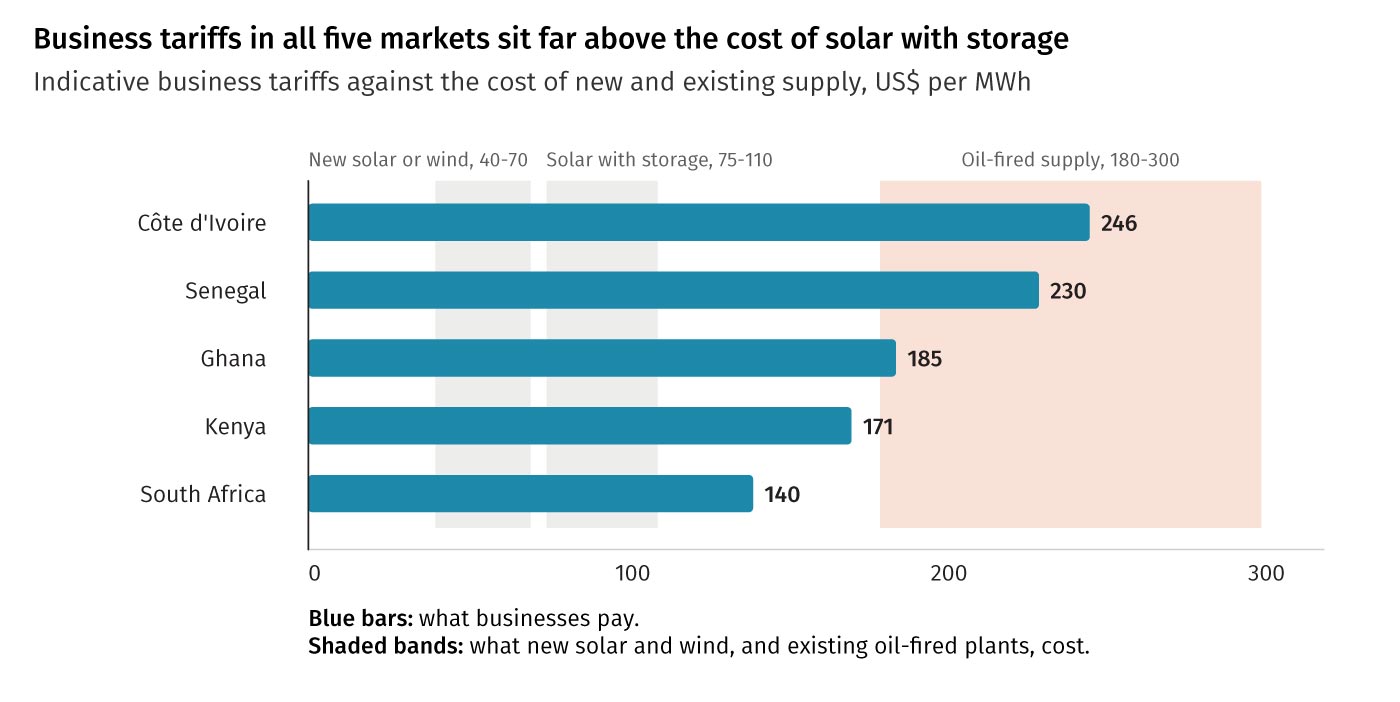
A tariff above the cost of generation is a margin to work with, not full cost recovery: networks, balancing and older contracts still have to be paid for.
So the economics favour clean power, and investors say they are ready to fund it. What holds many back is the buyer of the electricity. This article sets out why, and proposes a way for state-owned utilities to answer the investors’ question without giving up control or the social goals they serve.
A mortgage, not a taxi
A solar farm is like a house bought with a mortgage. Almost all of its cost is paid up front, and the sun is free. Capital accounts for roughly 50–70% of the lifetime cost of a solar plant with storage. A diesel generator is more like a taxi: cheap to procure, but you pay more on every journey.
That difference changes what many investors worry about. Engineering, construction and weather are risks that contractors, insurers and sound design can manage. They differ little from one country to another. What decides whether a project is financed, and at what price, is the buyer. Lenders recover their money over 15-20 years and equity investors over 20 to 25. They need confidence that the buyer will pay every month for that whole period.
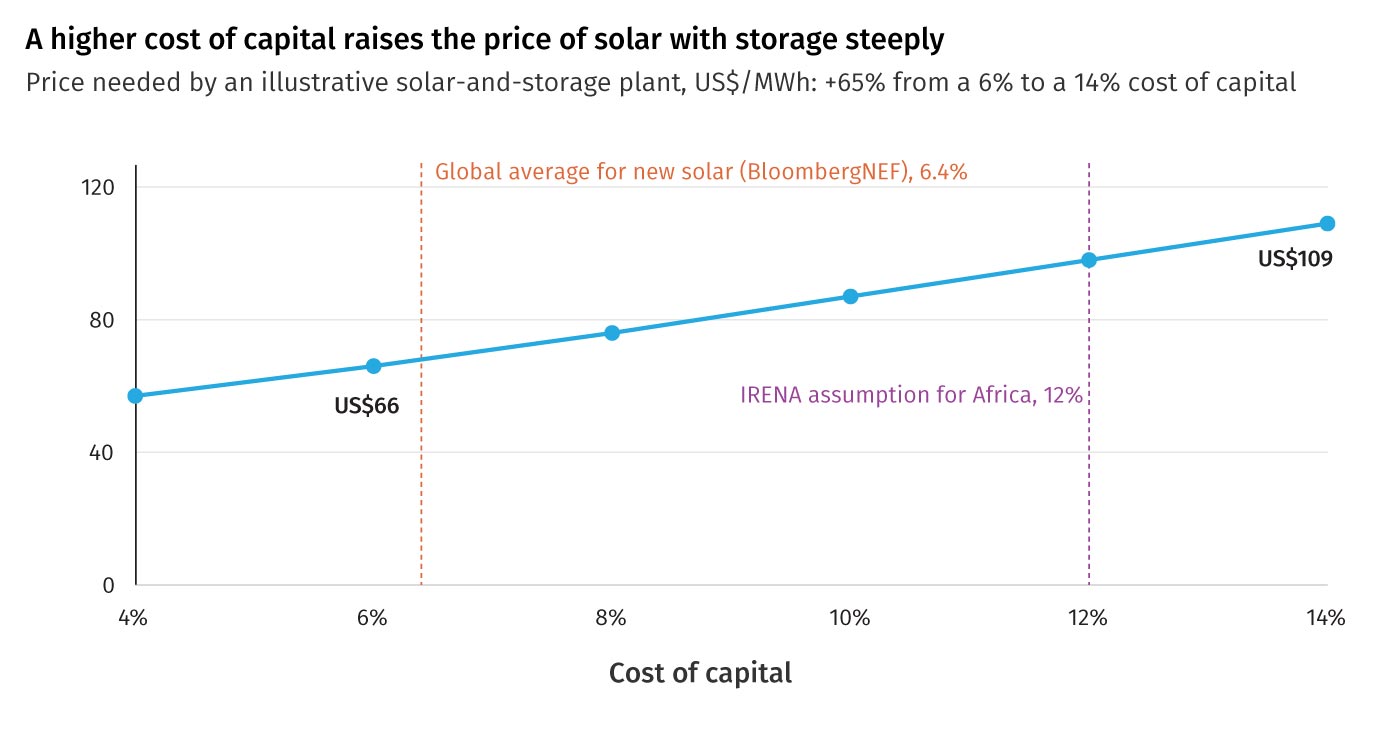
In most African markets that buyer is a single state-owned utility. Its credit sets the cost of capital, and the cost of capital sets the price of clean power. The International Energy Agency finds that financing makes up around half the lifetime cost of a solar plant in emerging and developing economies, against 25–30% in advanced ones. In our illustrative model, moving from a 6% to a 14% cost of capital raises the price a solar-and-storage plant needs by about 65%. Every point of perceived risk ends up in the electricity price.
Timing matters as much as eventual payment. Lenders expect repayments every quarter whether or not the buyer has paid, and developers price that risk into every bid. When a buyer is slow, cash has to be locked away in reserve accounts as security, and that money earns nothing. On one wind farm selling to a single state utility, replacing such reserves with bank letters of credit freed around US$14m for the project. A buyer that pays on time removes much of that cost at the source.
Good reasons, heavy costs
Utilities are not ordinary companies. They must serve every customer and keep basic electricity affordable. Governments support them for sound reasons: low tariffs for small users help poorer households, cheaper connections widen access, and stable prices shield homes and firms from swings in world oil prices. In Rwanda, a lifeline tariff halved prices for low-income households while connections doubled.
These goals work like a family budget. Those who earn more contribute more, so that everyone is fed. Businesses typically pay higher tariffs, and households on social tariffs pay less than the power costs to supply.
Senegal shows both the commitment and its price. Medium-voltage businesses pay about €200 per megawatt-hour. In January 2026 the regulator cut the social tariff for the first 150 kWh a month by 10%, for about 2.6 million small customers, at a cost of about €28m this year. The utility’s 2026 revenue falls short of what the regulator judges to be the full cost of supply by roughly a quarter, and the state covers the gap. Energy subsidies in the revised 2026 budget reach about 3.4% of GDP, more than three times the amount first budgeted. Public bodies also owe the utility more than €270m in unpaid bills.
When public finances tighten, as they have in Senegal this year, those transfers arrive late. The utility runs short of cash and the delay passes down the chain to the independent producers and their lenders. Investors may expect to be paid in the end, but they cannot be sure when. They price that uncertainty in.
The usual remedies all lean on the same government. Letters of credit cover a few months of payments and must be topped up when the utility’s cash is tightest. Sovereign guarantees add to the state’s contingent liabilities at a time when about 20 Sub-Saharan countries are in, or at high risk of, debt distress. Political-risk insurance pays only after a dispute has run its course, not when a monthly bill is late. None of these changes who the buyer is.
A buyer investors can trust, owned by the utility
A model that can work for many investors is that the utility creates a wholly owned subsidiary to buy new renewable power. Ring-fenced in law and in its accounts, this buyer signs long-term contracts with independent producers chosen by open tender. It sells the power to the utility’s most reliable customers, its commercial and industrial users, at the tariffs they already pay. Households and public bodies stay with the utility on today’s terms.
The heart of the design is where the money goes. Business customers pay into an account held by an independent trustee, usually a bank, which pays out in a fixed order:
- The power producers, for electricity delivered.
- A reserve covering three to six months of those payments, held outside the state banking system.
- A regulated charge to the utility for carrying the power over its grid.
- Dividends to the utility as owner.
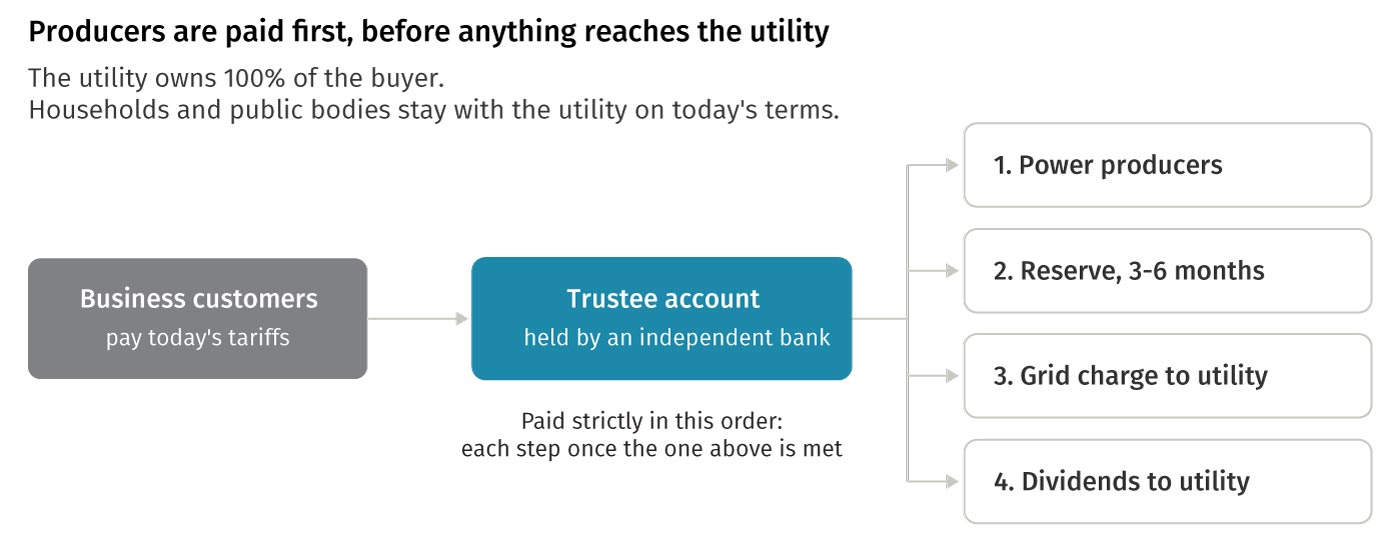
The buyer’s charter forbids it to borrow, to lend to the utility or to guarantee the utility’s debts. Producers no longer depend on the finances of the whole utility, or on transfers from the treasury. They depend on a defined group of business customers whose payments cannot be diverted.
This is how the buyer can earn a better credit standing than the government itself. Rating agencies already rate about 100 companies and public bodies above their governments, and S&P’s criteria state plainly that the sovereign rating “does not act as a ceiling”. A buyer that passes the agencies’ government-default stress test can sit several notches higher. Better credit means cheaper loans, and cheaper loans mean cheaper power.
Each part of the design has worked somewhere. In Zambia, Africa GreenCo, a licensed buyer and trader, enabled a 100 MW solar plant to raise commercial debt in 2025 without a government guarantee. India’s Solar Energy Corporation holds a domestic AAA rating, above the state utilities it sells to. Britain contracts its new clean power through a company its government owns. What is new is putting these parts together inside the utility, so that control and the dividends stay with the state.
What other countries teach
The programmes that have drawn large volumes of private capital into clean power share a few traits. They have a buyer investors trust, standard contracts, a published pipeline of rounds, and a habit of listening to the market before setting the rules.
- Britain. Under its Contracts for Difference scheme, generators sign standard contracts with the Low Carbon Contracts Company, which the government owns and which is funded by a levy on electricity suppliers. Each round follows public consultation. Offshore wind prices fell by about two-thirds between the first round in 2015 and the fourth in 2022. Consultation also corrects mistakes. In 2023 the ceiling price for offshore wind was set below what projects cost, and no offshore wind farm bid. The ceiling was raised for the next round and bidders returned.
- South Africa. The Renewable Energy Independent Power Producer Procurement Programme ran open tenders with bidders’ conferences, standardised contracts and a dedicated public office. Its first four rounds, between 2011 and 2015, brought 6,328 MW and US$20.5bn of investment. That was more than the rest of Sub-Saharan Africa had drawn through independent producers in two decades. Bid prices fell by about three-quarters for solar and by half for wind.
- Argentina. The RenovAr auctions held investor roadshows before launch and backed payments with a dedicated trust fund and a US$480m World Bank guarantee. The second round drew offers of 9.4 GW for 1.2 GW on offer, and prices fell by about a third.
- India. The Solar Energy Corporation of India buys power from producers and sells it on to state utilities, backed by a payment security fund. It holds a domestic AAA rating, above the utilities it serves.
Two cases point the other way, and they shaped our design. Morocco built its Noor solar complex through a state agency created beside the national utility. The utility buys Noor’s output below its production cost, leaving the agency with reported losses of about US$80m a year. Coordinating two public bodies proved hard: moving the utility’s renewable plants to the agency took from a 2016 law to late 2020, and their roles were divided again in 2025. In Nigeria, the state bulk buyer had no protected revenue of its own. Press reports put arrears to power producers at 6.5 trillion naira, with about a third of invoices collected. An intermediary without ring-fenced cash passes arrears along the chain rather than resolving them.
Hence the two choices at the core of our proposal. The buyer should sit inside the utility, so that it takes no assets or mandate away from it. And its cash should be ring-fenced, so that producers are paid whatever happens upstream.
What it could deliver
Two gains need to be kept apart. The first and larger one comes from replacing oil- or coal fired power with solar and wind, whoever buys it. The second comes from the structure itself: a more reliable buyer lowers the cost of finance. In our illustrative model, a loan margin two percentage points lower cuts the price of power by about 6%. The structure’s real test is whether it gets projects financed that would otherwise not happen, at a price the system can afford.
Senegal shows the scale. Fewer than 3,900 business customers buy about 36% of the utility’s electricity, worth about €400m a year. Most of the costliest supply comes from heavy-fuel-oil plants and powerships, floating power plants rented under contract. Once those contracts expire, replacing them with solar and storage for the whole business book could save the state-owned power sector in the order of €260m a year, within a wide range of roughly €130–390m. That is several times the cost of this year’s social-tariff cut. It would also cut Senegal’s carbon dioxide emissions by about a tenth and reduce its exposure to oil prices. Each US$10 rise in the price of a barrel would otherwise add about US$30m a year to the cost of supplying those customers.
No country should start with its whole business book. A sensible first step is about a tenth of it, or an industrial park whose demand is new: in Senegal around €215m of private investment. Each later step would go ahead only if the regulator confirms that the utility and its remaining customers gain.
Five markets to start
We screened all 54 African countries on tariff headroom, business demand, the legal route for private supply, the need for cheaper power, currency stability and grid readiness. Five markets lead: Senegal, Ghana, Côte d’Ivoire, South Africa and Kenya. Each would need its own version of the model.
- Senegal combines wide headroom, costly oil-fired and powership supply, and a currency pegged to the euro. Its debt restructuring and IMF programme are the things to watch.
- Ghana already allows private supply and wheeling, and burns costly liquid fuels. Its currency is volatile, and take-or-pay gas contracts mean that moving existing load can raise costs rather than cut them.
- Côte d’Ivoire has the highest business tariff and shares Senegal’s currency, but cheap domestic gas sets its costs. There the buyer would serve new demand and replace businesses’ diesel generators, and the private concessionaire that runs the grid would need to agree.
- South Africa has the largest business market, with rules for traders and wheeling already in place. Coal sets the cost most hours, so savings come mainly from diesel peaking plants and new demand.
- Kenya has high tariffs and a strong grid, but already makes close to nine-tenths of its power from geothermal, hydro and wind. Its case rests on payment security and new demand.
In a central case, the five could bring about 8.6 GW of solar with storage and about US$8bn of private investment to financial close within ten years, avoiding about 7 million tonnes of CO2 a year by year ten. Benin, Togo and Morocco come next in the screen, and Tanzania could test a version without storage.
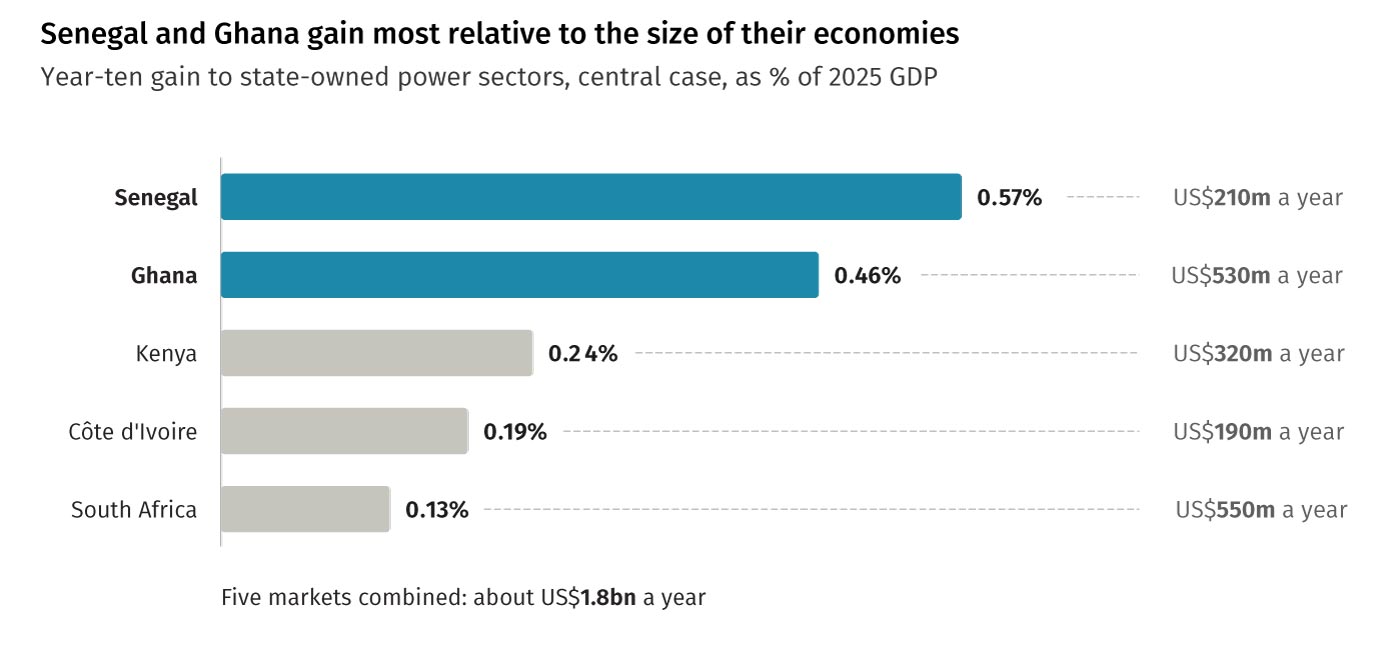
In dollars, South Africa and Ghana would gain most; relative to the size of their economies, Senegal and Ghana would. Across the 28 African markets with enough business demand, the long-run ceiling is far higher, but it is an upper bound. All these figures are estimates for a country diagnostic to test, not forecasts.
Beyond the power sector
The gains above are financial: money the state-owned power sector no longer spends on fuel and expensive contracts. They are not, by themselves, additions to national output. What they do to GDP depends on how the savings are used and on how much of the new activity would have happened anyway. We have therefore not added them up into a single growth figure. The channels through which they reach the wider economy are nonetheless clear, and some can be measured.
Protection from oil shocks. Every megawatt-hour of oil-fired power that is replaced stops moving with the world oil price. In the central five-market case, each US$10 rise in a barrel would otherwise add US$76–85m a year to the cost of supply. The jump of about US$30 a barrel between 2021 and 2022 would have added US$80–90m for Senegal’s business customers alone. After the 2026 Middle East conflict, IMF staff warned that higher oil prices would add pressure on Senegal’s budget through energy subsidies. Solar and wind priced in long-term contracts fix that cost for 20 years and more.
A stronger external balance. Fuel that is no longer imported eases pressure on the currency. The oil burned to supply Senegal’s business customers is worth about 0.5–0.7% of GDP a year, or 10–14% of its 2025 current-account deficit. Across the five markets, avoided fuel imports reach US$0.75–1.4bn a year by year ten. Part of the power payments flows abroad as debt service and dividends, so the net gain is smaller; local equity and local-currency loans raise it.
Reliable power for firms. In the latest World Bank surveys, 72% of firms in Sub-Saharan Africa reported power outages. Research finds that weak power supply cut the region’s annual growth by about 2 percentage points between 1995 and 2007. Firms that buy from a ring-fenced buyer gain firmer supply at a predictable price, and many could retire diesel generators that cost them US$0.28–0.40 per kWh.
Local spending and jobs. Building the plants keeps part of the investment at home, in construction, transport, services and wages. South Africa’s renewable programme reports 50% local content and about 92,000 job-years by the end of 2025. If 35% of the five-market investment were spent locally, it would mean about US$2.6bn of domestic spending over ten years.
New investment. Power-hungry industries follow reliable, competitively priced electricity. Africa had about 0.4 GW of data-centre capacity in 2024, with demand expected to reach 1.5–2 GW by 2030, and operators increasingly want clean power. Steadier public finances and dependable supply can also draw labour-intensive manufacturing, from garments to agro-processing. These effects are real but uncertain, and we leave them unquantified.
Lower emissions. Africa produces less than 3% of the world’s energy-related carbon dioxide, but its electricity demand is growing faster than the world’s. Every oil or gas plant built to meet that growth locks in emissions for decades. Each megawatt-hour of oil-fired power replaced avoids about 0.7 tonnes of CO2.
What must be true
The model is not free of risk, and its weak points are worth naming.
The first is the utility itself. Business customers are its best payers and the ones who fund cross-subsidies. Once their payments go first to producers, the utility carries more of the strain when times are hard. The network charge and dividend must leave it no worse off, and that has to hold under stress, not just in an average year. Its other customers, its older debts and its existing lenders all need to be part of the test before the first customer moves.
The second is the fuel that new supply would replace. Savings exist only where renewables displace something costlier. Where gas sets the cost, as in Côte d’Ivoire, moving existing customers would lose money; there the buyer should serve new demand and replace businesses’ own diesel generators. Senegal is bringing domestic gas into its power system, and that will narrow the margin over time.
The third is batteries. Some business customers use power at night. A plant with modest storage cannot supply a round-the-clock factory alone, so the utility must provide top-up supply, often from the very plants the buyer aims to replace. Projects must be sized with this in mind.
The fourth is credibility. A ring-fence set up by decree can be undone by decree. Investors will look for firm legal foundations, an independent trustee, a legal opinion that the buyer’s revenue is protected if the utility gets into difficulty, and the endorsement of the finance ministry. Where a government is restructuring its debt, as Senegal now is, the International Monetary Fund will want to see that the structure supports public finances rather than moving revenue beyond the reach of other creditors.
Where to begin
None of this requires a new national agency or a tariff increase. It requires a ministry of energy willing to lead, a utility willing to own the buyer, a regulator willing to govern each transfer and a finance ministry willing to protect the buyer’s cash.
The sequence is practical. Start with a diagnostic of the business customer book, the costly contracts that new supply would replace and the grid that must carry it. Design the contracts with investors, lenders and developers in the room, and test every proposal against one question: would it change an investment decision? Commission an independent shadow rating before the first tender, so that the buyer’s credit is tested rather than assumed. Then run open, standardised tenders on a published timetable, starting with new demand or an industrial cluster.
Customers should move in a deliberate order. New demand comes first, because serving it takes nothing away from the utility. Next comes load that the utility currently serves at a loss on fuel alone. Last comes load matched to oil-fired contracts as they expire, when the full cost of those plants can finally be avoided. Before each step, the regulator checks that the utility’s grid charge and dividend at least make up for the margin it gives up, and can claw money back if a tranche falls short.
The timetable can be short if the work runs in parallel. Setting up the buyer, with its licence, charter, trustee account and shadow rating, takes about 12 to 18 months. Meanwhile the ministry can announce its ambition, publish draft contracts for comment and hold a bidders’ conference, and launch the first tender around month 12. On the timings achieved in South Africa and Argentina, the first project could reach financial close within about two years.
Set-up would cost about US$2–4.5m per country, in the order of 1–2% of a first Senegal tranche, and readiness funds from development partners can cover much of it. That is small beside the investment it can unlock.
Investors’ test is simple: a buyer that pays on time, every month, for 25 years. A utility that can offer one gains cheaper power, more room to fund social tariffs and new connections, and less exposure to the oil price. The first country to do it will set the template for others.
This article draws on TIL’s white paper “Unlocking private investment in African renewable power” available here (October 2026). Figures are indicative and come from public sources and the authors’ own analysis.