Disasters devastate local economies. But every so often, they might also make way for renewal as disaster-hit towns rebuild. A key deciding factor between these two outcomes is whether money reaches those who can put it to best use while they rebuild.
Galveston, Texas, is a good place to see this. Hurricane Ike flooded the island in September 2008, two days before Lehman Brothers collapsed, so credit was drying up across the country at the exact moment the town needed it most. The U.S. president had declared the hurricane a major disaster––a designation that unlocks substantial federal money for infrastructure, households, and low-interest business loans. That money takes months to reach a business, but not many businesses in Galveston could afford to wait. Neither could the banks: “if Galveston business didn’t recover, we’re all going to be damaged,” said Vic Pierson, president of Moody National Bank. So, Pierson and his counterparts from three other local banks in Galveston met in waterlogged offices lit by generators and agreed to lend to island businesses for six months, unsecured, at 5 percent, until insurance checks and federal aid came through. They lent more than $40 million and helped keep businesses afloat.
The telling part is who got those bank loans. The banks lent based on credit history and long relationships because there was little else to lend on: for instance, much of the island’s property had just flooded, often without insurance, and property values were declining, so collateral was worth less and harder to judge than it had been a week earlier. This meant that businesses without an established, long relationship with a local banker were told to wait (potentially for months) for the federal programs. Galveston eventually recovered, thanks mainly to its tourist trade and the federal money once it arrived, but went without about a sixth of its pre-disaster residents, who relocated away.
It is not hard to imagine that the set of firms which might have survived and rebuilt or Galveston’s path of recovery might have been different had the banks not prioritized relationship lending, or had federal money not been available at all. There is of course no counterfactual to Galveston’s case, and it thus cannot tell us what could have been definitively. My paper, “Cleansing Floods? Creative Destruction and Government Spending after Disasters,” gets at this by comparing declared disasters against non-declared ones that did not receive federal disaster assistance: the comparison lets me ask whether public money changes who gets to rebuild, and whether and how that changes what the local economy looks like afterward. It does so in the context of flooding––a disaster that is often of smaller scale than Hurricane Ike, but one that is also the most common and one of the costliest disasters in the U.S.
Specifically, I examine manufacturers’ outcomes and aggregate productivity in American counties hit by large floods. I focus on manufacturing because factories mostly sell to customers far away, so their performance does not rise and fall with local spending, which flooding and flood-related aid can both affect. That makes them a clean setting for studying productivity rather than local demand.
How and why exactly does financing matter for post-disaster rebuilding and productivity? Since Joseph Schumpeter in the 1930s, economists have described downturns (which disasters could be characterized as well) as “cleansing”: the weakest firms are culled and their workers, machines, and buildings are freed up for more productive use. This churn from less to more productive firms, which economists call creative destruction, is what drives productivity growth in healthy economies, and a flood might accelerate it. Exit is what the disaster itself triggers, but it alone does not lead to renewal. For that, the resources that weak firms leave behind have to flow to productive survivors and to high-potential new entrants, and that is where financing, and government spending, come in. Whether federal money helps is far from obvious: it could help creative destruction by expanding financing access for dynamic firms––typically young small firms that create a disproportionate share of new jobs and ideas but tend to face credit constraints. Yet, it could also distort the quality of reallocation: it may crowd out private bank lending––which is typically more efficient than government lending––or cheap federal loans may prop up weak, forever-indebted “zombie” firms that should have closed, further stifling the economy. Conversely, if federal aid is not available at all, private lenders are likely to behave the way Galveston’s banks did. This primarily disadvantages young and small firms, which have no long banking relationships and little collateral to spare. A flood-hit town that loses its small entrepreneurial firms risks losing the very engine that could have driven its renewal.
To distinguish between these hypotheses, my analysis combines FEMA’s records of declared floods, and a hazard database of severe floods that were not declared, with confidential plant-level data from the U.S. Census Bureau for 1977 to 2017. In particular, I use rich data from the Annual Survey of Manufactures, which follows 50,000 to 70,000 factories each year and records their output, employment, and, crucially, their investments in machinery and buildings, including whether the machinery was bought new or used. The Census Bureau’s Longitudinal Business Database lets me track each plant from birth to death, along with its year-to-year employment and payroll. I focus on counties that flooded rarely, so that each event is plausibly a surprise, and compare how plants fare in the years after a flood relative to their own pre-flood baselines.
Three findings stand out for declared floods. First, I find that floods weed out the weakest plants. The probability that a plant shuts down within two years rises after a flood by more than a third relative to its pre-disaster average. But the increase is concentrated among plants that were already in the bottom quartile of productivity within their narrowly defined industry before the disaster arrived. In other words, the flood delivers a final blow to factories that were already lagging behind their peers.
Second, survivors upgrade their machinery as they build back. Plants that stay in business scrap and sell off far more machinery than usual in the years after a flood, partly because water corrodes metal and so speeds up depreciation. But these survivors more than replace what they lose, often with brand-new equipment. In a survey I conducted on Midwestern manufacturers, executives described flooding as an “opportunity to modernize.” As one put it, “when replacing by necessity, [we would] stay current.”
Third, young plants and new entrants buy second-hand machines and build up their capacity. The local supply of used machinery grows as exiting plants and upgrading survivors sell off their equipment, which gives young and new plants a more affordable way to acquire capital. One might worry that second-hand machines, especially after a flood, carry outdated technology or are rusty and near the end of their useful lives, either of which would hold back entrants’ productivity. Cheap used equipment might also attract low-quality entrepreneurs. I find no evidence of either concern. In fact, plants that enter after a flood are substantially––by about 14 percent––more productive than those that entered before. Part of this reflects better management: young firms respond to disruptions in more nimble and structured ways than older firms do.
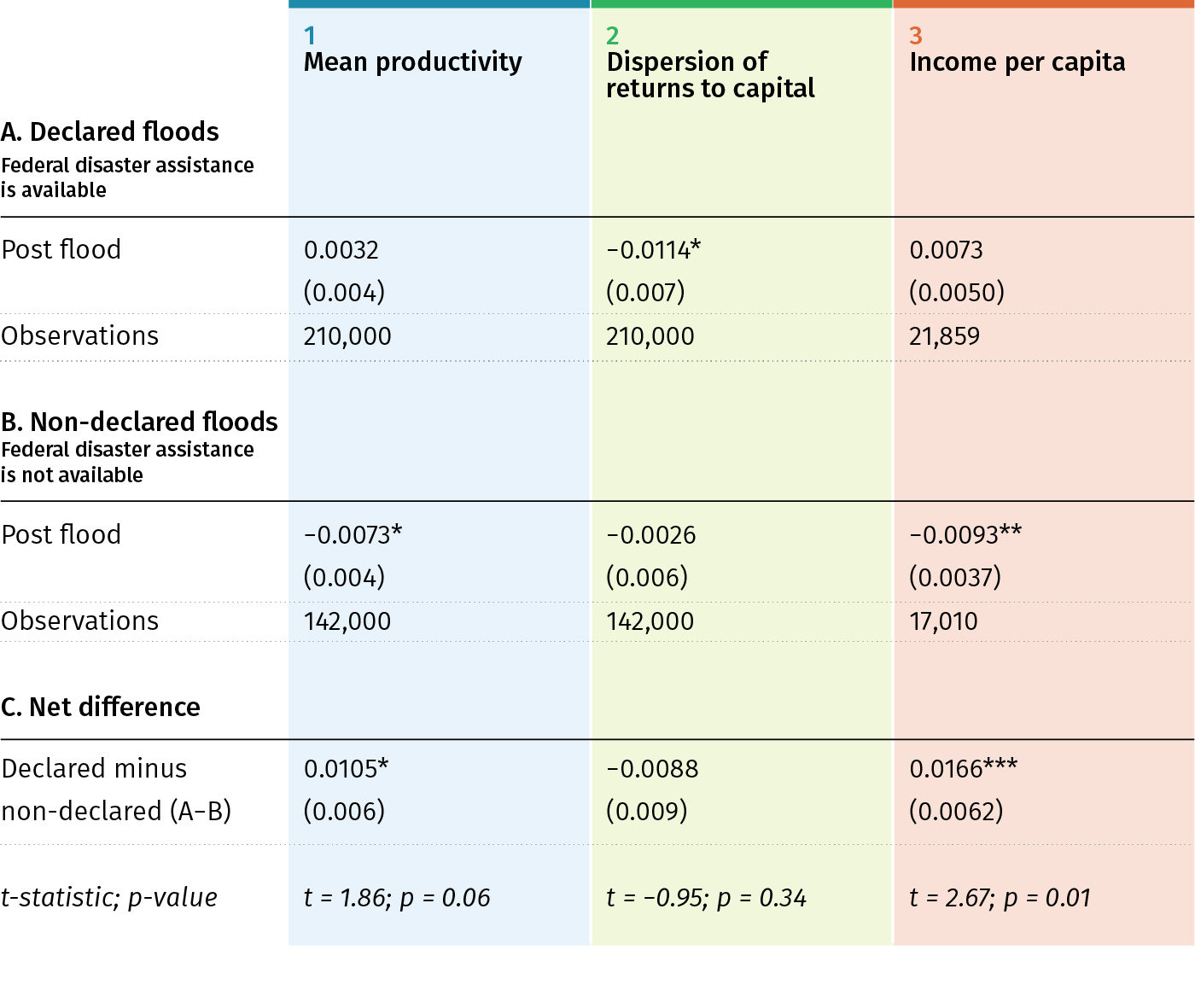
Taken together, my findings suggest that capital moves toward the plants that can make the best use of it after declared floods. As column (2) of Table 1 shows, the gap in returns to capital between high- and low-performing plants in the same county and industry narrows after a flood, which is what improved resource allocation looks like at the aggregate level.
A key mechanism for these results is that federal disaster spending expands financing access, particularly for the young firms that play an outsized role in reallocation. Bank lending in counties with declared floods rises by about 3 percent, especially in the smallest loan sizes, which young and small firms rely on most. Without federal spending––as after severe floods that never received a declaration––recovery looks markedly different: no rise in small-loan lending appears after non-declared floods so small and young firms do not appear to enjoy expanded credit access. Further, after such non-declared floods, exits rise among productive and unproductive plants alike, post-flood entrants show no productivity advantage relative to pre-flood ones, and aggregate productivity in the affected areas falls by about 0.73% rather than recovers (see Table 1). Thus, creative destruction is stifled after non-declared floods.
Federal disaster assistance, then, facilitates creative destruction. But at what cost, given that disaster risks are growing while government resources remain finite? To study this, I calculate the bang for the buck of federal disaster spending: the income gains that flooded counties receive per dollar of net cost to the government. I find that per capita incomes fall by close to 1 percent after severe but non-declared floods but rise modestly after declared ones. The gap between the two, more than 1.6 percentage points, is the contribution of federal assistance to income recovery. This improved income recovery generates additional tax revenue that fully offsets the roughly $38.5 billion that U.S. disaster recovery agencies spent upfront on flood recovery between 1993 and 2017. In other words, the upfront cost of federal spending on declared disasters can be recouped through later tax revenue.
Three caveats are in order. First, the results do not imply that floods are a “net good” or that anyone should want to be flooded. The comparison this paper speaks to is, conditional on a flood happening, whether broad-based government rebuilding support makes a difference to recovery relative to a scenario where that support is not available. Second, the paper carries no implications for frequently flooded coastal regions, where relocating may dominate rebuilding as climate prospects worsen; my sample excludes such regions and focuses on infrequently flooded counties for econometric reasons. Still, my findings speak to the many regions in the U.S. and around the world, including inland places with little historical disaster experience, where climate change is projected to raise the risk of severe but still infrequent flooding. Third, my study focuses on aggregate outcomes and productivity and is silent on other important post-disaster phenomena. Even if average county incomes rise, the gains may accrue to a few who were already well off, and workers at the factories that shut down may be pushed into long-term unemployment or less promising careers, widening inequality. Nor does my analysis capture the non-pecuniary costs of flooding, such as its psychological toll. These questions fall beyond the scope of my paper but merit serious research.
Well-funded, well-managed disaster programs that deliver financing quickly can thus have an important spillover: they draw private loans into disaster-affected regions. In the U.S., at least, some of these programs also fund hazard mitigation, so recovery money can double as adaptation money. Galveston’s bankers lent because they knew federal money was on its way, and the firms they did not know were left waiting on that same money. Both halves of the story depend on the public dollars being there. Where they are, private credit reaches further down to the small and the new, and a flooded town gets a chance at renewal rather than just repair. Where they are not, the firms that would have led the renewal are the first to go. As climate change magnifies flood risk even for regions with little history of it, disaster recovery financing will only become more consequential.