

South Asia’s Demographic Dividend and Employment Challenge
South Asia is home to nearly 2 billion people, with more than 45% of the population below the age of 25. Across the region, the formal sector is unable to generate sufficient employment opportunities to absorb the more than one million new entrants joining the workforce each month.
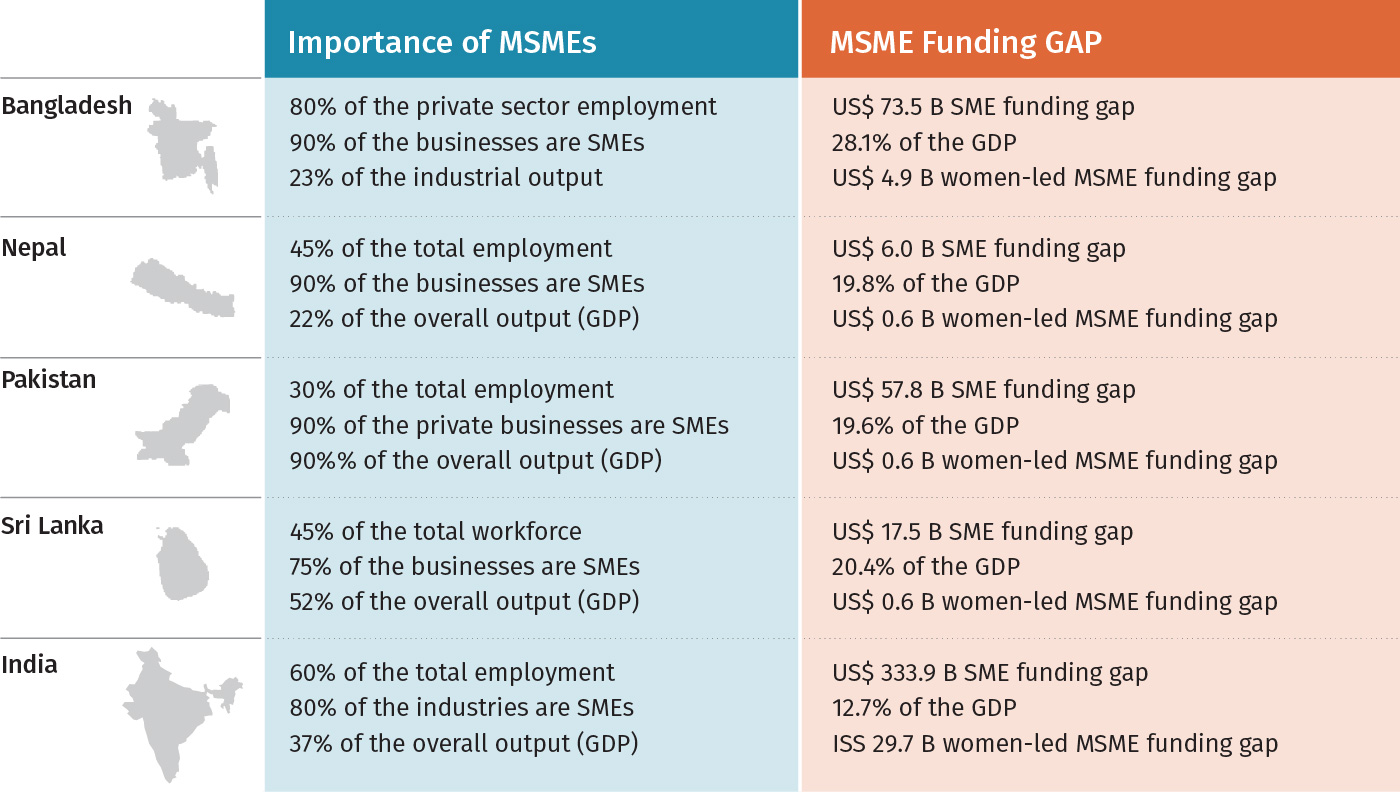
Like most emerging and frontier markets, where SMEs create about 70% of all jobs, South Asia relies heavily on small and medium enterprises (SMEs) as a key driver of employment and economic development. In India and Bangladesh, for example, SMEs account for approximately 60% and 80% of total employment , respectively, and contribute more than one-third of GDP.
The Financing Gap Holding SMEs Back
Despite their significant contribution to employment generation and economic growth, around 40% of formal SMEs in developing economies report an unmet financing need, according to the IFC . This challenge is particularly acute across South Asia, where SMEs remain chronically underserved by traditional financial institutions and capital markets, limiting their ability to invest, scale, and realize their full economic potential.
The exhibit below highlights the economic importance of SMEs and the magnitude of the financing gap they continue to face across key South Asian markets.
The Missing Middle: A Severe Growth Equity Shortage
The risk-capital gap facing SMEs is particularly severe in the equity financing segment. For example, despite a decade of robust economic growth, a young population (median age ~27; 180 million population ), and an economy approaching USD 500 billion, Bangladesh continues to lag significantly in attracting private capital.
In fact, aside from a mid-sized fund in Nepal, there appears to be very little dedicated capital for SME growth equity across the region outside India. At the same time, a growing number of impact investors have shifted their focus toward venture-backed technology businesses. In competing for limited LP allocations alongside traditional venture capital funds, many impact investors have concentrated on themes such as climate tech, fintech, agri-tech, and, more recently, AI-native and AI-enabled startups.
The relative ease of securing follow-on funding and achieving successful exits has further incentivized investors to move up the innovation curve, leaving growth-stage SMEs increasingly underserved. As a result, a large segment of otherwise viable and scalable SMEs remains constrained by limited access to growth capital, despite their proven business models, established market positions, and significant potential to generate employment and economic value.
The South Asian Valuation Arbitrage Opportunity
This structural shortage of risk capital has created a valuation arbitrage opportunity across South Asia.
While India has successfully developed a functioning SME capital market ecosystem, most other South Asian countries continue to operate with shallow and underdeveloped capital markets that are ill-equipped to meet the financing needs of growing SMEs. As a result, comparable businesses across the region, despite having similar operating performance, growth trajectories, and market positions, often trade at valuation multiples that are three to five times lower than those of their Indian counterparts.
There may be an argument that Indian SMEs deserve higher valuations due to India’s stronger sovereign risk profile and more favorable macroeconomic fundamentals. While differences in country risk do contribute to valuation premiums by reducing investors’ required rates of return and, consequently, lowering equity discount rates, the authors’ estimates suggest that these factors justify a valuation differential of no more than 1.3x to 1.5x.
The wider valuation gap observed in practice therefore points to a market inefficiency and a potential opportunity for investors capable of accessing high-quality SMEs across the broader South Asian market.
Emerging Structural Tailwinds
The opportunity is further reinforced by shifting regional dynamics. Large conglomerates and family offices are increasingly unable to attract entrepreneurial talent , as next-generation family members are either reluctant to join legacy businesses or lack the operational competence required to drive growth.
This shift is creating space for professionally managed, growth-oriented SMEs to gain market share and emerge as future regional leaders.
SMEs and the Energy Transition
Growth capital for SMEs is also, in part, transition capital. Export-oriented SMEs in garments, leather, agri-processing and light engineering sit inside the supply chains of European, Japanese and North American buyers, many of which have set emissions targets that extend to their suppliers. Evolving rules on sustainability reporting and supply-chain due diligence, particularly in the EU, push the same requirements down the chain. For a garment factory in Bangladesh or a food processor in Sri Lanka, keeping a buyer increasingly means measuring energy use and emissions, installing rooftop solar, and replacing inefficient boilers and motors.
These upgrades often pay back within a few years, but they compete for scarce capital with working capital and capacity expansion, and bank credit in the region tends to be short-tenor and collateral-based. Growth equity can fund them as part of a broader modernisation plan, and the governance that comes with an equity partner makes the resulting emissions data more credible to buyers. Whether SME funds deliver this depends on making energy and emissions an explicit part of how they build portfolio companies.
One Response: Mycelium SME Fund
Mycelium SME Fund (MSF), launched in 2025 with a target size of US$50 million and an initial focus on Bangladesh and Sri Lanka, seeks to address the structural financing gap facing scalable SMEs in South Asia through a focused mid-market growth equity strategy.
The fund uses a standardized deal structure and valuation framework, which it expects to shorten execution timelines, improve scalability, and enable the investment team to devote greater attention to value creation and exit preparation.
Its value creation strategy centers on facilitating regional partnerships and joint ventures that combine local market knowledge with scale-up expertise from developed markets, while also creating access to capital, commercial opportunities, and business development support.
Investment Focus
MSF focuses primarily on export-oriented and B2B businesses, where greater transparency and stronger operating metrics can help mitigate concerns around governance, portfolio management, and exit challenges commonly associated with SME investing.
To further reduce execution risk, the fund invests in SMEs that have already demonstrated operational capability through scale, typically generating annual revenues exceeding US$5 million, with established profitability and positive cash flow generation.
Because exits are the hardest part of SME investing in the region, the fund has formed partnerships with M&A advisory firms in Japan and Southeast Asia to widen the pool of potential acquirers.
Risks
The case for SME growth equity in South Asia carries risks that investors should weigh. Governance and financial reporting in family-controlled firms are often weak, and minority investors have limited legal recourse. Currency risk is material: the Sri Lankan rupee and the Bangladeshi taka both depreciated sharply after 2022, eroding dollar returns even where local performance was strong.
Both economies have also been through recent shocks, Sri Lanka’s 2022 sovereign default and Bangladesh’s 2024 change of government, which affect policy continuity and access to foreign exchange. Exits remain the hardest problem: local equity markets are thin, and reliance on trade buyers ties returns to cross-border M&A appetite. A small fund also carries concentration risk, with a handful of investments determining its outcome.
Conclusion
South Asia’s SME sector sits at the intersection of demographic tailwinds, chronic capital scarcity, low valuations, and increasing demand for business modernization. Yet the region remains underserved by growth-equity capital.
Funds such as MSF are one attempt to fill this gap. Their success will depend on disciplined selection, active governance and credible exit routes and, for the transition, on whether energy and emissions become part of how portfolio companies grow.